

Updated on 18.05.2026
At a medical exhibition or trade show, timing is rarely flexible. A stand has to be built, devices need to be positioned, demonstrations must be ready, and sales teams expect the equipment to arrive exactly when promised. When the items being moved are specialist devices, monitors, display units, diagnostic tools, or other forms of medical equipment, the delivery is no longer a simple parcel movement. It becomes part of the event itself.
That is where a specialist courier service makes a real difference. A standard parcel delivery service may be suitable for ordinary boxes, but medical exhibitors often need careful handling, secure transportation, clear communication, and timed collection and delivery. As a medical equipment courier, we understand that the item in the vehicle is not just a shipment. It may be the centrepiece of a product launch, a live demonstration, a supplier meeting, or a brand presentation in front of healthcare industry decision-makers.
For exhibitions and trade shows, reliable delivery is not only about reaching the destination. It is about getting the right equipment to the right door, stand, venue, or loading bay, without confusion, avoidable delay, or unnecessary stress.
Why exhibitions need more than a standard courier service?
A trade show delivery has its own rhythm. There are booking slots, venue instructions, loading zones, security checks, stand numbers, contact names, and strict deadlines. If the courier misses a timed access window, the whole process can be disrupted. For a medical supplier, manufacturer, clinic group, or healthcare business, that delay can cost valuable time, money, and customer confidence.
This is why a specialist courier service is often more suitable than a basic parcel delivery option. A parcel delivery service is usually built around volume, routes, and standardised processes. Exhibition logistics are more specific. The courier may need to collect from a warehouse, office, supplier location, or clinic, transport the equipment securely, then deliver directly to an exhibition venue or event stand.
For medical events, reliability is often more important than speed alone. Express delivery can help when timings are tight, but the real value comes from controlled handling, clear communication, and a team that can support the delivery from collection to destination. When needed, clients can be updated by phone or message, so they know when important equipment has been collected, delivered, or handed over.
Choosing the right courier affects more than the delivery itself. It can influence brand reputation, customer satisfaction, and operational efficiency at the event.
Medical courier services for the healthcare industry at trade shows
Medical courier services support a wide range of organisations across the healthcare industry. These may include hospitals, clinics, GP surgeries, surgery centres, equipment suppliers, healthcare technology companies, and medical manufacturers. At exhibitions, these businesses often bring products that need to be handled with more care than general display materials.
A medical courier may be asked to transport demonstration devices, diagnostic equipment, monitors, surgical display models, technical components, branded exhibition materials, supporting documents or presentation equipment. In some cases, the items are high-value. In others, they may be delicate, awkwardly shaped, or difficult to replace quickly if damaged.
This matters because medical events are often connected to wider healthcare outcomes. The equipment displayed at a trade show may later be used in hospitals, clinics, or GP surgeries to support quality patient care. Even though the exhibition itself is commercial, the products being presented can have a practical role in the way patients are diagnosed, monitored, or treated.
Medical exhibition logistics is a specific part of healthcare transport. The focus is usually on demonstration devices, display equipment, technical components, monitors, branded materials, and other items needed for a stand or product presentation. These shipments depend on secure handling, careful packing, timed transport, suitable vehicles, and clear communication at each stage.
Delivery services for safe collection, transport and stand delivery
The most important part of medical exhibition logistics is control. From courier collection to final delivery, every step should be planned around the nature of the equipment, the venue, and the event deadline.
As a medical equipment courier, the task begins before the vehicle arrives. We need to understand what is being collected, where it is going, how it is packed, whether it needs a larger vehicle, whether a tail-lift may be required, and whether the delivery point is a loading bay, reception area, stand space, or another agreed location. Good planning helps reduce risk and avoids the kind of last-minute confusion that can make event days stressful.
Medical equipment couriers may handle a comprehensive range of items, from small monitors and compact devices to larger technical units. Some equipment may require extra packing, secure positioning in the vehicle, assisted loading, or careful unloading at the destination. Where agreed in advance, support may also include unpacking, positioning, or helping clients prepare the item for display.
The drivers and support team also matter. Exhibition deliveries are often time sensitive, and venues can be busy, especially during build-up and breakdown periods. A dedicated courier who understands the process can assist with smoother collection and delivery, protect the shipment during transport, and keep the client informed if venue access or traffic conditions change.
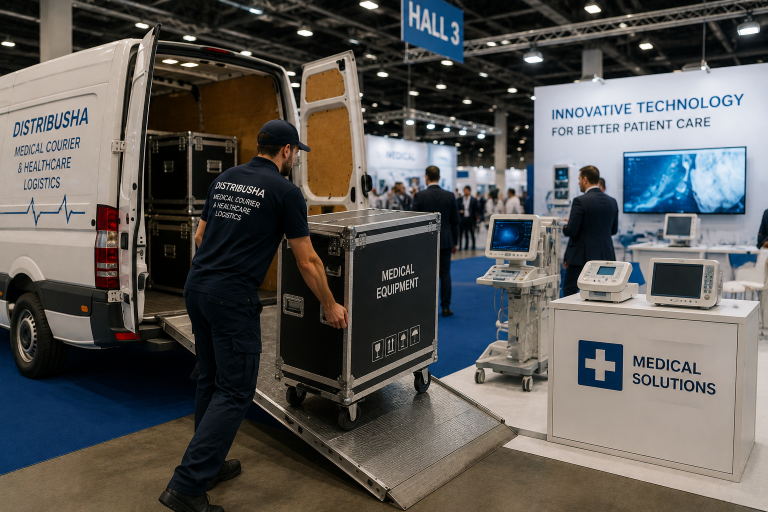
Courier collection, day collection and venue access planning
A good courier collection is not just a pick-up. It is the beginning of the delivery plan.
For exhibitions, day collection may involve collecting from a supplier, warehouse, office, hospital department, clinic, or storage facility. The courier needs the correct address, contact name, phone number, access instructions, item count, and packing details. If the equipment is being collected from a busy business location or healthcare setting, timing should be agreed carefully so that staff are not left waiting, and the shipment is ready to move.
Venue access also needs attention. Exhibition centres may require delivery passes, stand numbers, booking references, loading bay instructions, or specific delivery windows. A courier who understands these details can help clients save valuable time and avoid repeated calls on the event day.
Express delivery service when timing is critical
An express delivery service becomes essential when exhibition timelines are tight. Medical suppliers often work to fixed deadlines: a stand built in the morning, a product demonstration in the afternoon, or a meeting with potential customers at a set time. If a box of brochures is late, it is inconvenient. If the main medical equipment for the stand is late, it can affect the whole event.
Express delivery is especially valuable when plans change. A replacement part may need to be delivered the same day. A forgotten cable, monitor, document pack, or display unit may need urgent delivery. A supplier may need to send parcels or larger equipment after the original shipment has already left. In these situations, speed matters, but it must be matched with reliable delivery and secure handling.
Clear communication also improves the process. When several people are involved, such as the sender, the event team, the venue contact, the stand builder, and the person waiting to receive the equipment, simple updates can help everyone stay aligned. If requested, Distribusha can confirm collection, provide delivery updates, or let the client know when the equipment has been delivered.
For medical exhibitions, express delivery should feel controlled, not rushed. The goal is not simply to deliver fast. It is to be delivered correctly.
Same day, next day and day courier service options
Different exhibition shipments need different delivery services. Some items can move by next-day delivery, especially when the event schedule allows extra preparation time. Others require same-day delivery because the item is urgent, time-sensitive, or needed for immediate setup.
A day courier service can be useful when the client needs a direct, dedicated route rather than a multi-stop parcel process. This may include a day of collection from a supplier and a day of delivery to an exhibition venue, clinic, hospital, office, or local business address. For medical equipment, this type of service gives more control over the shipment and reduces unnecessary handling.
Same-day and next-day options also help clients balance cost, urgency, and operational needs. Not every delivery has to be treated as an emergency, but when the timing is critical, having access to express delivery and flexible transport options can protect the event plan.
Across the UK, medical exhibitors need couriers who can adapt to venue locations, city traffic, local access rules, and the specific needs of each shipment.
Medical equipment courier standards: packaging, documents and shipment control
A medical equipment courier must understand that exhibition items should not be treated like ordinary parcel delivery. Even when the shipment is not regulated in the same way as clinical materials, it can still be high-value, fragile, awkward to move, or essential to the success of the event.
For exhibitions and trade shows, the focus is usually on safe packing, secure loading, suitable transportation, accurate venue details, clear communication, and careful handover. The courier needs to understand what is being moved, how it is packed, where it needs to arrive, and whether the client needs support with unloading, positioning, or return collection after the event.
This is especially important for medical demonstration devices, monitors, technical units, branded displays, and other equipment that may be difficult to replace at short notice. The aim is to make sure the shipment arrives in the right condition, at the right location, and in time for the stand or demonstration to be prepared properly.
What should not be treated as ordinary parcel delivery?
A medical device, a diagnostic unit, a monitor, a technical display system, or a specialist demonstration product should not be treated in the same way as a standard parcel. These items may be fragile, expensive, bulky, difficult to replace, or central to the success of an exhibition stand.
That distinction is important when booking any delivery services. Before arranging shipping, the client should be clear about the item type, value, packaging, size, weight, urgency, destination, venue access requirements, and any support needed at the delivery point. A courier service can then discuss whether the item is suitable for the available service, whether enhanced cover may be needed, and whether special arrangements are required.
For exhibition work, this conversation also protects the client. It avoids underestimating the shipment, helps prevent delays, and gives the customer service team the information they need to assist properly.
How Distribusha supports exhibitions across the UK?
Distribusha supports exhibition and event logistics across the UK, helping clients move materials, display items, technical equipment, and medical equipment to venues where timing and presentation matter. We work with businesses that need more than a standard parcel courier. They need a service that can collect, transport, and deliver with attention to the event schedule.
For healthcare suppliers and medical exhibitors, this may include collection from a warehouse, supplier, office, or business site, followed by delivery to an exhibition centre, hotel venue, conference centre, arena, or trade show location. Depending on the shipment, the process may also involve larger vehicles, careful handling, support with unloading, and communication with the person receiving the items.
International courier service requirements may involve separate cross-border arrangements, but for UK-based exhibitions, the priority is often local knowledge, reliable transport, accurate timing, and practical support on the day. A courier who understands UK venues can help clients avoid problems around loading bays, door access, stand delivery, and return collection after the event.
Clients can use the website or phone to discuss the shipment, explain their specific needs, and arrange a courier plan that matches the exhibition schedule.
Choosing the right medical equipment courier for your next event
Choosing the right medical equipment courier should never be based on cost alone. Price matters, of course, but the cheapest option can become expensive if the equipment is delayed, damaged, misdirected or delivered to the wrong part of a large venue.
The better question is whether the courier can support the full process. Can they collect at the right time? Can they handle the equipment safely? Can they work with venue instructions? Can their team respond if details change? Can they support same day, next day or day delivery requirements? Can they offer a dedicated route when the shipment is too important for unnecessary handling?
Insurance and cover should also be discussed, especially when transporting high-value equipment. Standard goods-in-transit cover may not always be enough for specialist items, so clients should check what protection is available before confirming the shipment.
Businesses that send parcels regularly may also want to set up an account, review costs, discuss recurring delivery needs, and test the service with a few shipments before relying on it for larger events. A good courier relationship should save time, reduce stress, and give clients peace of mind.
Work with Distribusha for medical exhibition logistics
When your exhibition depends on safe, timely, and professional transport, the right courier service becomes part of your event preparation. At Distribusha, we help clients plan collection, transport, and delivery around the realities of trade shows, healthcare events, and UK exhibition venues.
Whether you need to deliver medical equipment to a stand, arrange courier collection from a supplier, organise day collection and day delivery, or discuss a time-sensitive shipment, our team can help build the right process around your equipment and destination.
Medical exhibitions move quickly. The courier should not be the part that creates uncertainty. With careful planning, secure handling, and clear communication, your equipment can arrive where it needs to be, when it needs to be there, ready for the people who rely on it.
UK venues for medical equipment exhibitions and trade shows
The following is a list of events that we know of where we believe you are likely to be exhibiting/demonstrating your medical equipment:
Med-Tech Innovation Expo https://www.medica-tradefair.com/
Med-Tech Innovation Expo (NEC page) https://www.thenec.co.uk/whats-on/med-tech-expo/
Medical Technology UK https://www.medicaltechnologyuk.com/
Medical Technology UK (via Medical Technology Ireland) https://www.medicaltechnologyireland.com/exhibitor-information/medical-technology-uk
EBME Expo https://ebme-expo.com/
Therapy Expo https://www.therapyexpo.co.uk/
MEDICA Trade Fair https://www.medica-tradefair.com/
Med4Nexus https://med4nexus.com/
NHS Confed Expo https://www.nhsconfedexpo.org/
Primary Care Show https://www.primarycareshow.co.uk/
Future of Surgery Show 2026 https://igpp.org.uk/event/The_Future_of_Surgery_Show_2026
MedicalExpo https://www.medicalexpo.com/
Smallfry – Medical Device Design https://smallfry.com/medical-device-design
Europlaz Events 2026 https://europlaz.co.uk/europlaz-events-2026/
MedTech Innovation Ireland https://www.medtechinnovation.ie/about-the-event-2/become-an-exhibitor/
Frequently Asked Questions
Before booking a medical equipment courier, it is helpful to provide the collection address, delivery venue, stand number, contact details, item dimensions, weight, packaging condition and any access restrictions. This allows the courier team to choose the right vehicle, plan loading and unloading, and avoid delays at the exhibition venue. For larger or fragile medical equipment, photographs and handling notes can also make the process smoother.
Yes, some courier and parcel delivery services use dimensional weight, which considers how much space a parcel or item occupies in the vehicle, not only its physical weight. This is especially relevant for exhibition materials, display units and medical devices that may be light but bulky. For accurate cost planning, businesses should share full measurements before confirming the shipment.
Clear communication helps both the sender and the recipient stay aligned during time-sensitive exhibition deliveries. At a trade show, this matters because teams often work around fixed build-up times, venue access windows and scheduled demonstrations. If requested, Distribusha can confirm collection, provide updates, or let the client know when the equipment has been delivered.
For important exhibitions, it can be sensible to test a courier service with a smaller or less critical shipment first. This helps clients assess communication, collection timing, handling standards and overall reliability before trusting the courier with high-value medical equipment. For businesses sending regular shipments, this also creates a clearer basis for discussing account options and long-term delivery needs.
Not always. General exhibition materials such as brochures, banners or lightweight displays may be simpler to move, while medical equipment can be more fragile, valuable, bulky or time-sensitive. For this reason, the courier process should be planned around the specific nature of the shipment, including packing, loading, vehicle type, venue access and timed delivery.
Contact Us
Rely on Distribusha for all your same-day courier service requirements. Reach out to us today to discover how we can best assist you
Get a quote
Recents posts:

Logistics for Exhibitions in the UK: A Complete Business Guide
Автор: An exhibition delivery has more than one destination. The venue postcode gets the driver to the site. The hall, loading zone and stand number
Medical Courier Services in Birmingham: What Businesses Need to Know
Автор: Medical deliveries go wrong for surprisingly ordinary reasons. The driver is given the hospital but not the department. A diagnostic unit is booked as

Courier Services in Manchester for Urgent Deliveries: Complete Guide
Автор: An urgent courier service in Manchester should collect a time-sensitive consignment in a suitable vehicle and take it directly to the recipient, without sending