
Updated on 18.05.2026
In healthcare, a delivery is rarely just a delivery. A missing part, a delayed hospital bed, a late piece of mobility equipment, or a poorly handled medical device can affect schedules, discharge planning, and the people waiting at the end of the chain. That is why medical courier services need to be planned with more care than standard transport.
At Distribusha, we support the healthcare industry with reliable courier and logistics solutions for medical equipment, medical supplies, and technical healthcare machinery. Our work sits between logistics and patient care: making sure the right item reaches the right place, safely, securely, and with the urgency the situation requires.
Good medical logistics gives healthcare professionals valuable time back. Strong healthcare logistics help hospitals, private clinics, GP surgeries, suppliers, and patients avoid delays that should never become part of the care pathway.
The role of medical courier services in the healthcare sector
The healthcare sector relies on movement. Equipment moves between hospitals. Medical devices move from suppliers to clinics. Mobility aids and hospital beds move into homes so patients can be discharged safely. PPE, spare parts, and medical goods move on short notice when a team needs them quickly.
This is where medical courier services become essential. A professional medical courier does not simply collect and deliver. The service has to consider timing, access, handling, vehicle suitability, communication, and the condition of the item on arrival.
For healthcare professionals, this matters because logistics failures often create operational pressure. A delayed delivery can mean a delayed procedure, a longer wait for patients, or a lost working hour for a clinical team. Reliable delivery services help protect quality patient care by keeping medical items moving through the supply chain with less disruption.
A strong UK medical courier partner also understands that every client has specific needs. A private clinic may need a same-day medical delivery. A hospital may need larger equipment moved with tail lifts. A supplier may need ongoing support throughout the UK.
What a medical courier service does in practice?
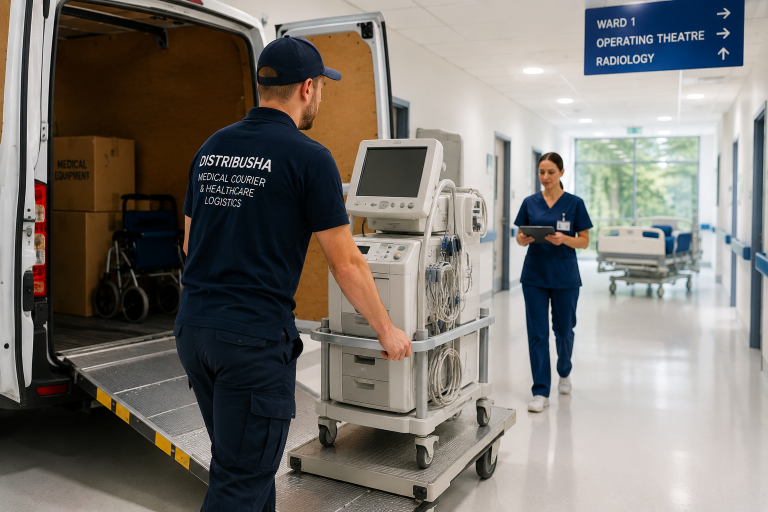
A medical courier service is built around careful transport, clear communication, and secure handover. In practical terms, this can include collection, loading, transportation, delivery confirmation, and, where required, support with the placement or installation of medical equipment.
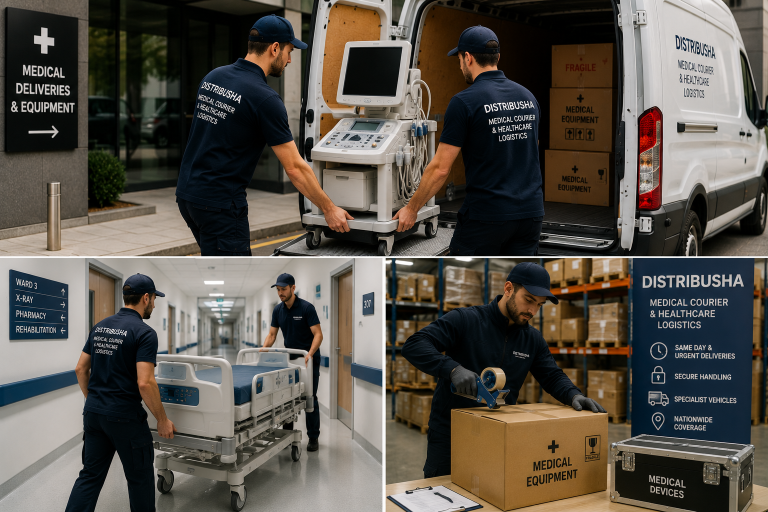
Medical courier work often involves items that are too important, too delicate or too time-sensitive for a general courier service. That may include hospital beds, mobility aids, monitoring equipment, technical healthcare machinery, medical devices, PPE, essential medical goods, and other equipment used in hospitals, clinics, laboratories, or home-care settings.
The detail matters. Larger items may require dedicated vehicles, suitable loading space, and tail lifts. Sensitive equipment may need careful restraint during transport. Urgent items may need direct delivery rather than multi-drop routing. Healthcare customers also need clear communication and reliable delivery confirmation, especially when the item is needed for patient care. Where required, this may include photos as proof of delivery or a recorded name, signature, date and time at handover.
A trained medical courier should understand the importance of the job before the vehicle leaves the depot. The task is not only to deliver quickly. It is to deliver safely, with the utmost care, and in a way that supports the people waiting for the item.
Medical equipment logistics for hospital beds, devices and home-care support
Medical equipment logistics is one of the most important areas of healthcare transport. It involves the safe movement of high-value, bulky, or sensitive equipment that must arrive in good condition and be ready for use.
This can include hospital beds, mobility aids, medical devices, technical machinery, spare parts, clinical equipment, and healthcare supplies. Some items are heavy. Some are fragile. Some are needed urgently because they affect discharge planning, treatment schedules, or home-care support.
For example, if a patient is medically ready to leave the hospital but is waiting for a bed, a hoist, or a mobility aid to be delivered at home, transport delays can add avoidable pressure to hospital capacity. Timely delivery of medical equipment can therefore help reduce unnecessary waiting, support smoother discharge, and improve the workflow between hospitals, families, patients, and care providers.
This is why secure transportation is not only about locking a vehicle. It includes choosing the right vehicle, planning the route, loading correctly, protecting the item in transit, and making sure the delivery is completed with proper communication. In medical equipment logistics, small operational details can make a large difference.
Why is a specialist medical courier different from a standard courier service?
A standard courier service may be suitable for ordinary parcels, but healthcare transport often demands more care. A specialist medical courier understands that medical goods are connected to clinical routines, patient comfort, and operational deadlines.
The difference starts with handling. Medical equipment may be expensive, sensitive, or awkward to move. It may need to be kept clean, protected from impact, loaded with the right equipment, and transported in a way that prevents unnecessary movement inside the vehicle. The courier also needs to understand the delivery environment, access points, and any practical instructions provided by the healthcare customer.
There is also a difference in communication. Healthcare clients often need to know when an item has been collected and when it has been delivered. Depending on the customer’s requirements, Distribusha can confirm delivery by phone, provide delivery updates when requested, send photos as proof of delivery, or collect a name, signature, date and time at handover.
A specialist courier also understands short-notice requests. In healthcare, plans change. A clinic may suddenly need equipment. A supplier may receive an urgent call from a hospital. A medical team may need support that cannot wait until the next routine delivery slot. That is why experience matters.
How do healthcare logistics protect patient care and daily operations?
Good healthcare logistics keep clinical operations moving. It supports hospitals, GP surgeries, laboratories, private clinics, equipment suppliers, and healthcare professionals by reducing uncertainty around delivery.
When equipment and medical supplies arrive on time, staff can focus on patients rather than chasing transport updates. When a courier gives accurate communication, clients can plan their day more confidently. When medical delivery is handled with care, the risk of damaged equipment, missed appointments, and repeated deliveries is reduced.
This is especially important across a busy healthcare supply chain. One item may pass through several points before it reaches the person who needs it: manufacturer, supplier, warehouse, courier, hospital, clinic, or home-care address. Each step needs accountability.
Reliable logistics solutions help protect that chain. They give clients confidence that their medical items will be handled properly, transported securely, and delivered in line with the specific requirements of the job. For healthcare, reliability is not a luxury. It is part of the service.
Same-day medical delivery and courier support across the UK
Same-day medical delivery can be essential when time is tight. Healthcare providers may need urgent delivery of PPE, replacement equipment, spare parts, medications, medical supplies, or technical support items. In these situations, delays can affect patient care, clinical schedules, and the ability of healthcare teams to work efficiently.
Our delivery services are designed to support urgent and planned requirements across the UK. Some clients need one-off support at short notice. Others need a more regular transport service for equipment, supplies, and healthcare logistics. In both cases, the goal is the same: safe, timely delivery with dependable communication.
A courier service for healthcare must be able to respond without becoming careless. Speed is important, but so are safety, handling, and documentation. Medical goods must be treated with respect from collection to handover.
With local expertise and nationwide reach, a trusted courier partner can support hospitals, clinics, suppliers, and laboratories throughout the UK, especially when internal teams do not have the time, vehicles, or flexibility to manage transport themselves.
Blood samples, biological samples, and test results: where compliance matters
Not every healthcare consignment belongs in the same category. Medical equipment and supplies are very different from blood samples, biological samples, pathology samples, organs, tissue, or medical waste.
Items such as blood samples and biological samples usually require strict packaging, classification, labelling, and chain-of-custody procedures. In the UK, UN3373 Biological Substance, Category B is handled under specific transport packaging requirements, including Packing Instruction 650. That is a separate compliance area and should not be treated like ordinary courier work.
The same applies to temperature-controlled logistics. Some medicines, pharmaceuticals, and clinical trial materials may require validated packaging, monitoring, and temperature-controlled vehicles. Refrigerated medicinal products must be packed and transported so that the required temperature is maintained throughout the journey.
For clarity, Distribusha’s core focus is medical equipment, healthcare supplies, and technical medical logistics support. We do not position ordinary equipment transport as specialist blood, organ, tissue, or medical waste transport. That distinction protects clients, patients, and compliance standards.
If patient-related documents are ever involved, data protection must be considered carefully. Health information is treated as special category data under UK GDPR, so this type of material should always be handled responsibly and in line with the customer’s instructions.
Local expertise from London and Manchester to healthcare sites nationwide
Healthcare delivery is never only about distance. It is also about access, timing, and local knowledge. A hospital site in London, a supplier near Manchester, a clinic in Cardiff, or a healthcare facility in Glasgow may all have different delivery windows, loading areas, security procedures, and expectations.
That is why, from London and Manchester to healthcare locations across the UK, local expertise matters. A courier who understands healthcare environments can reduce friction at the point of delivery. They know that the final few metres can be just as important as the journey itself.
For clients, this means fewer delays, clearer communication, and more confidence in the transport process. Whether the job involves medical devices, hospital beds, healthcare supplies, or technical equipment, the courier needs to understand both the route and the environment.
Across the UK, reliable medical logistics depends on people who can plan well, communicate clearly, and deliver with care.
Ongoing medical courier services for hospitals, clinics and suppliers
Some healthcare transport needs are urgent. Others are regular, planned, and repeatable. Ongoing medical courier services can help healthcare providers, suppliers, and clinics build a more dependable logistics routine without the cost and complexity of maintaining an in-house fleet.
Scheduled courier support is useful for organisations that move medical equipment, supplies, or devices between sites on a regular basis. It can also help suppliers who need reliable delivery capacity but do not want to manage vehicles, drivers, maintenance, and last-minute staffing issues internally.
The benefit of regular support is familiarity. When a courier team understands a client’s sites, routines, access points, and specific requirements, deliveries become smoother. Repeated routes can reduce admin pressure and give healthcare teams more predictable support.
For hospitals, private clinics, GP surgeries, laboratories, and healthcare suppliers, this kind of partnership can make everyday operations feel less reactive and more controlled.
Choosing a trusted partner for UK medical logistics
The right medical courier partner should bring more than vehicles. It should bring industry experience, trained couriers, clear communication, suitable transport services, and a practical understanding of healthcare pressure.
At Distribusha, we know that medical logistics is about trust. Our clients rely on us to transport equipment and medical supplies safely, respond when timing matters, and support healthcare operations with care. Whether the need is a same-day delivery, planned transport, secure movement of medical devices, or wider medical equipment logistics, the priority remains the same: reliable support for healthcare teams and the people they serve.
Strong healthcare logistics help protect time, equipment, and patient care. That is why every delivery deserves to be handled properly, from collection to final handover.
Frequently Asked Questions
Healthcare providers should look beyond speed and price. A reliable courier should understand healthcare environments, use suitable vehicles, provide delivery confirmation, and be able to explain how sensitive or high-value medical items are handled from collection to handover.
Yes. For many clinics, suppliers, and healthcare organisations, outsourcing transport can be more efficient than maintaining an in-house fleet. It reduces the need to manage vehicles, driver availability, maintenance, and short-notice delivery pressure internally.
Clear communication helps healthcare customers understand when important equipment or supplies have been collected, delivered, or handed over. Depending on the customer’s request, Distribusha can provide delivery updates, confirm completion by phone, send photos as proof of delivery, or record the recipient’s name, signature, date and time.
No. Medical equipment, devices, and healthcare supplies are not handled in the same way as blood samples, biological samples, radioactive materials, sharps, or clinical waste. Those categories can require separate packaging, classification, chain-of-custody procedures, and specialist compliance under frameworks such as UK GDPR, MHRA guidance, or ADR rules where relevant.
Delivery confirmation helps healthcare customers know that important equipment or supplies have reached the right place. When requested, Distribusha can provide practical proof of delivery, such as a photo, recipient name, signature, date and time. This gives customers added reassurance without adding unnecessary complexity to the delivery process.
Contact Us
Rely on Distribusha for all your same-day courier service requirements. Reach out to us today to discover how we can best assist you
Get a quote
Recents posts:

Logistics for Exhibitions in the UK: A Complete Business Guide
Автор: An exhibition delivery has more than one destination. The venue postcode gets the driver to the site. The hall, loading zone and stand number

Medical Courier Services in Birmingham: What Businesses Need to Know
Автор: Medical deliveries go wrong for surprisingly ordinary reasons. The driver is given the hospital but not the department. A diagnostic unit is booked as

Courier Services in Manchester for Urgent Deliveries: Complete Guide
Автор: An urgent courier service in Manchester should collect a time-sensitive consignment in a suitable vehicle and take it directly to the recipient, without sending