Transporting and Handling CBCT Machines: What Really Causes Damage
How many times in life do you find yourself saying: “Well, I never knew that”? This may well be one of those times as if we were to ask you where and when medical equipment is most likely to get damaged, you might think it will be while it is being transported between the supplier’s premises and the hospital, surgery or medical practice, or when the unit is being relocated, returned for servicing, or installed in an existing clinic.
Would it surprise you to learn that it is more likely during the unpacking and setting up of the machinery than during its transportation when most damage, if any, is likely to occur.
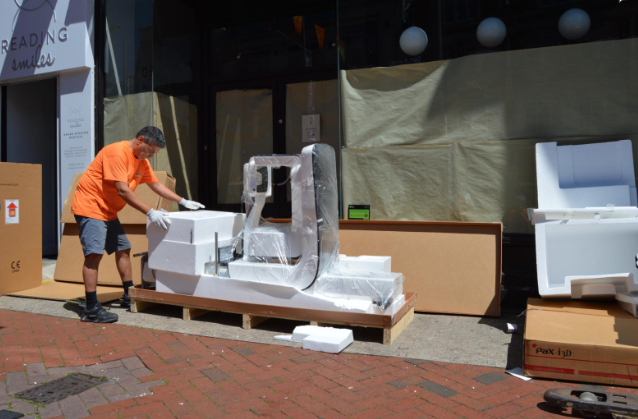
We decided to have a look at an example of the type of medical equipment we are asked to deliver and install for one of our clients. The medical equipment in question is a Cone Beam Computed Tomography (CBCT) scanner.
Now, it would be easy for you to be lulled into a false sense of security when you first see the scanner when it is packaged up ready for transport. It will look easy to move and because it is so robustly packaged to a manufacturer-approved standard, you might think that anyone with a van could transport it.
Now here’s the thing. Such robust packaging can lead to poor handling because it looks almost indestructible. Why take extra care when you won’t cause any damage? What you may not know or understand is that manufacturers design CBCT transport packaging to protect against vibration and minor impacts. However, this protection assumes:
- The unit is kept upright
- It is not dropped, knocked, or rolled
- It is handled using the correct lifting points
What is important to understand is that a CBCT machine must never be dropped, tipped abruptly, or rolled down ramps or steps, even when boxed as it is very easy for components to shift without visible external damage.
The Most Critical Moments for courier: Unpacking and installing
Here at Distribusha our medical equipment courier service doesn’t simply involve transporting a unit from A to B. In most cases, it also involves unpacking the unit and installing it in situ, ensuring it is fully operational if appropriate before we leave.
It won’t come as a surprise to discover that CBCT units are heavy, and manufacturers provide dedicated transport handles for a reason. These handles distribute weight through the frame that has been specifically designed to support it. So, what happens if those handles are ignored, removed too early, or not used correctly? When the machine is lifted or pushed, damage can occur, usually internally, but not always.
This is because external parts are not designed to provide structural integrity and, consequently, they are not designed to:
- Carry the weight of the machine
- Absorb lifting forces
- Be used as leverage points
This is especially critical around the rotating assembly, where the X-ray sensor and generator are located. These components are highly sensitive to shock and misalignment, are critical to the successful operation of the machine, and are very costly to replace. Consequently, you could save a few pounds on delivery and end up paying thousands in repairs because of an inexperienced delivery service.
Now, in the above we have talked about transporting and unpacking a brand-new scanner, but what happens if you want to transport a pre-used one?
Older CBCT Machines: A Different Challenge
The crate and packaging protecting a brand-new scanner are bulky, by their very nature. As a consequence, it is rare for these materials to be retained once the scanner has been unpacked and installed. In fact, as part of Distribusha’s medical equipment courier service, we will take away all packaging materials and where appropriate, take them to a recycling depot. So, what is the downside of removing all this packaging?
Well, if you have sold it and are upgrading, there is an immediate and new challenge. How do you ensure it won’t get damaged in transit?
What we have discovered is essential for the safe transportation of the scanner when the original packaging is missing is:
- Custom padding
- Controlled positioning within the vehicle
- Load restraint that prevents micro-movement
- An understanding of where forces can and cannot be applied
Once inside the vehicle, the equipment must be:
- Positioned to maintain correct orientation
- Protected from vibration and lateral movement
What you may discover to your cost is that poor vehicle positioning can cause cumulative stress during transit, even on short journeys. However, there is an external factor that may not have crossed your mind when it comes to the delivery of such a scanner. The building where the scanner is going to be installed.
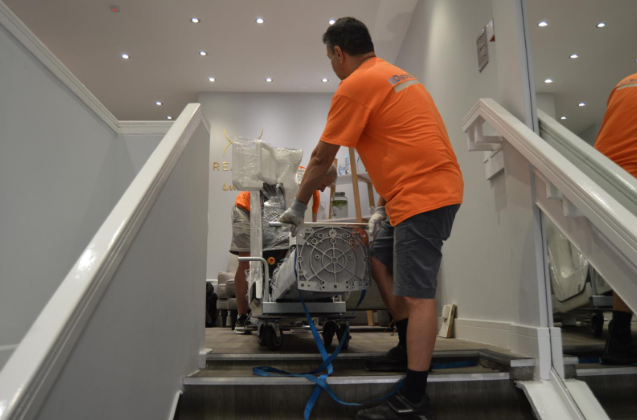
When it comes to providing medical courier services, we have found that many dental and medical clinics operate out of older buildings which present a problem with:
- Narrow staircases
- Tight corridors and sharp turns
- Limited ceiling height and door width
Consequently, to ensure safe handling in these locations requires comprehensive route planning before delivery can begin to ensure there can be controlled manoeuvring through tight access points. You will also need to have complete awareness of load-bearing floors and staircases, and ensure there is clear communication between handlers
Why Experience Matters More Than Speed
It is an unfortunate fact of life for those who ‘do a job’ as opposed to those who offer a professional service, and that is an inbuilt desire to complete a job as quickly as possible. At Distribusha, our reputation has been built on the back of providing a faultless, comprehensive and professional courier service where the company’s emphasis is always about doing things right and not as quickly as possible. Yes, if we say we will be there by a certain time, we will be there, but nobody has ever complained because we have taken our time to install the equipment once we have arrived.
In Conclusion
CBCT machines are resilient when treated properly, but unforgiving when handled incorrectly. The biggest risks are not encountered during the journey itself — they are those moments when lifting, unpacking, manoeuvring, and positioning the scanner. Understanding those risks, and knowing how to manage them, is what separates Distribusha from a general courier.
Got any questions? Call us: 01923 828460 – it costs nothing to talk – or
Email us: info@distribusha.co.uk and we’ll get straight back to you.
Need a quick quote? Use our Quote Form for a rapid response.
Recents posts:

Why You Should Use a Professional Medical Equipment Courier
If you are looking for a reliable courier service in Northampton, and especially a time-critical same-day courier in Northampton, how do you know what to look for when making such an important choice?

Can Couriers Deliver Bulky and heavy Equipment?
If you are looking for a reliable courier service in Northampton, and especially a time-critical same-day courier in Northampton, how do you know what to look for when making such an important choice?

What is the Difference Between a Delivery Service and a Courier Service?
If you are looking for a reliable courier service in Northampton, and especially a time-critical same-day courier in Northampton, how do you know what to look for when making such an important choice?