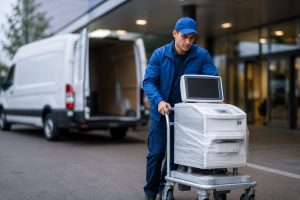
last mile delivery

What does last mile delivery mean, especially for a technical courier or medical courier delivery?

The term ‘last mile delivery’ can perhaps be misleading as it is not a part of a courier delivery service you haven’t heard of before and most definitely is nothing to do with the literal ‘last mile’ of a courier service. In fact, without wishing to confuse you, there can be more than one ‘last mile’ when it comes to a supply chain deliver, but the usual last mile relates to the final stages of a product delivery after it leaves the producer or manufacturer. It applies to the delivery from the supplier to a retailer, or the retailer to the end purchaser, of a product initially manufactured in a different country and which has to go through a distribution centre.

To give you an example, let’s look at a technical courier service and a 3-D printer manufactured in Taiwan. Now not all 3-D printers are the same, and for a business that specialises in the 3-D manufacture of technical parts, these are not the sort of printers you can buy in the high street. However, there are suppliers of such 3-D printers and so the elements of a last mile delivery service for a printer could either be from the coastal port or airport to the supplier, or it could be from the supplier to their customer. In the courier delivery world, these are also referred to as a B2B (business-to-business) courier delivery, and a B2C (business-to-customer) courier delivery.

Last mile delivery does not really apply to a delivery chain with only one stage. In other words, if a local supplier has an item in stock, the delivery of that item to the customer would simply be a delivery as there is only one link in the chain. However, for a company such as Amazon, say, you can order an item from them and the last mile delivery will be the delivery to you by either the parcel courier or, in the UK, it may be Royal Mail. While you may think that buying direct from Amazon and they are the supplier selling direct to you, there would be no last mile delivery, you would be wrong. This is because Amazon operates through a distribution network where it has multiple warehouses dotted around the country. Those warehouses deal with orders and once dispatched, those orders are dispatched to a central distribution outlet. From there the items are delivered to a local distribution outlet, and from there the last mile delivery services take place.

Why is last mile delivery the most critical step in logistics?

If you are anticipating the delivery of a product that was manufactured abroad, then it is more than likely you will be given an approximate date for delivery. If its arrival at the distribution hub is delayed by three or four days, this is an accepted risk and not uncommon. The fault is not usually attributed to the manufacturer but the cargo handler, and they are not companies that product recipients usually contact. Consequently, they avoid being blamed for any delays even if they are at fault.

However, once in this country and once the items have cleared customs, there is no excuse for poor last-minute courier delivery services and any delay. In other words, there should be no excuses for any delays one the item to be delivered is ‘available for collection’. Because the courier, and especially if a medical courier or technical courier, is acting on behalf of the supplier, the service provided needs to be faultless.

courier from manchester to london

How does technology improve last mile delivery efficiency?

Bar codes! While these were first associated with supermarket shopping, they have become a key component for tracking goods from manufacturer to the end consumer. Bar codes are easily scanned and todays IT has developed a system where digital alerts (e.g., an SMS text) can instantly alert the courier company when an item is ready for collection. In addition, once collected, a new barcode can be used and shared with the client so they can follow progress of the delivery – this is a great way of ensuring there will be someone available at the point of delivery and can considerably reduce the number of failed deliveries.

Why choose Distribusha for your last mile delivery service for medical and technical equipment?

Experience, reliability, and the ability to deal with virtually any type of product, and especially those which relate to medical and technical equipment. Distribusha’s main strength comes in the form of our most valuable assets, our couriers, who are highly skilled individuals and not just at driving our vehicles. Our couriers are also trained to install technical and medical equipment so that it is ‘up and running’ prior to their departure. In addition, we take responsibility for removing all old equipment for recycling, and we remove all packaging materials for recycling as well.

There is no set period of time for last mile deliveries. This is because it literally does not simply cover the last mile but the whole journey, usually from warehouse to customer. That distance can vary considerably depending on where the collection and delivery points are.

From the Distribusha point of view, delays to last mile delivery tend to be at source and part of the journey to the destination warehouse or distribution centre, and not part of the ‘last mile’. What could delay things once the item or goods at the warehouse or distribution centre would be a lack of knowledge that the goods were ready for collection, a lack of available courier staff to collect the goods, a lack of available vehicles, or having nobody available at the destination to take the delivery. Here at Distribusha we always know where products are and exactly when they are ready for collection. We also have a full compliment of couriers available and plenty of vehicles, even for rush and last-minute courier deliveries

The main reason for a failed delivery attempt is because there is nobody at the receiving end to sign for the delivery. The main reason for that is a lack of communication, Here at Distribusha, we don’t set out to deliver anything until we have confirmation that someone will be there to take delivery, that is the easiest way to avoid failed deliveries.

Distribusha transports medical devices, diagnostic equipment, hospital supplies, sterile instruments, and technical healthcare machinery. However, we do not transport biological materials such as blood, organs, or human tissue. We deliver not only to hospitals and laboratories, but also to private individuals for residential care equipment, such as medical beds, gas bottles, mobility equipment.

Recents posts: