
Updated on 18.05.2026
Moving technical equipment is rarely as simple as booking a van and waiting for a delivery confirmation. Anyone who has had to move a diagnostic device, a piece of IT hardware, a machine part, or a fragile unit from one site to another knows this already. The risk is not only that something arrives late. The bigger concern is that it arrives damaged, incomplete, badly handled, or not ready for use.
That is where technical logistics solutions become important. They sit somewhere between courier work, site support, careful handling, and practical problem-solving. The job may involve transport, but it may also involve lifting, positioning, installation, removal of old equipment, packaging, disposal, and communication with several people along the way.
For businesses in healthcare, technology, engineering, retail, laboratories, and other specialist sectors, this kind of service can make a real difference. Distribusha works with customers across the UK who need sensitive equipment moved safely, quickly, and with more attention than a standard delivery service would usually provide.
Why are technical courier services not the same as standard delivery?
Standard delivery has its place. For ordinary parcels, documents, and simple shipments, it usually does the job well enough. But technical equipment is different. It may be valuable, fragile, awkward to lift, difficult to access on site, or needed urgently because another unit has failed.
That is why technical courier services require more planning. Before collection, the courier needs to understand what is being moved, how it is packed, whether it needs two-person handling, whether a tail lift is required, and what should happen when the equipment reaches the delivery point.
A technical courier is not there just to leave a box at the door. Depending on the request, the work may include careful placement, minor assembly, installation support, or collection of replaced equipment. That is a very different level of service from a normal drop-off.
For the customer, the value is not only in safe delivery. It is in the entire process being managed properly, from pickup through to the final point of use.
1. Technical couriers for sensitive equipment, machinery, and spare parts
Some equipment simply cannot be treated like a standard parcel. IT and networking equipment, audio-visual systems, laboratory instruments, medical devices, industrial machinery components, and testing equipment all need more care during transport.
This is one of the main reasons businesses use technical couriers. The items being moved may be expensive, but value is not the only issue. Some devices are sensitive to shock. Others are bulky and difficult to carry through buildings. Some are needed on a specific date because engineers, staff, or clients are already waiting for them on site.
A reliable technical courier service has to think about the details that often get missed: access routes, lifting requirements, timing, secure handling, packaging conditions, and who will receive the shipment. If any one of those points is ignored, the delivery can quickly become more complicated than expected.
For businesses dealing with technical equipment, that level of care is not a luxury. It is often the difference between a smooth handover and a problem that causes avoidable downtime.
2. Medical equipment support through technical courier services
Medical equipment delivery has its own pressures. Healthcare sites, dental practices, laboratories, suppliers, and manufacturers often work to tight schedules. Equipment may be needed for appointments, diagnostics, treatment rooms, testing areas, or day-to-day clinical operations.
Distribusha supports the movement of medical equipment and medical devices, including items that may need careful handling, suitable vehicles, and trained people. This can include equipment for hospitals, dental surgeries, laboratories, and healthcare suppliers.
It is important to be precise here. Medical equipment courier work is not the same as transporting biological materials. Items such as blood, organs, tissue, or medical waste require very specific licensing, vehicles, and handling procedures. The focus here is on equipment and supplies, not those restricted medical materials.
For customers, timing matters. A delayed device can affect a schedule. A damaged unit can interrupt work. A poorly coordinated delivery can leave staff with equipment in the wrong place, still boxed, or not ready for immediate use. Good technical courier services help reduce those problems by treating the shipment as part of a working healthcare environment, not just as freight.
3. Bespoke service for heavy lifting, unusual equipment and specialised vehicles
Not every technical delivery fits into a neat category. One shipment may involve a compact device in protective packaging. Another may involve heavy equipment, several boxes, awkward access, stairs, loading restrictions, or a strict delivery window.
This is where a bespoke service becomes useful. Instead of trying to force every delivery into the same model, the courier team can plan around the actual request. What is being moved? How heavy is it? Is the equipment already packed? Will it need lifting? Is there space for a van close to the site? Does the old unit need to be taken away?
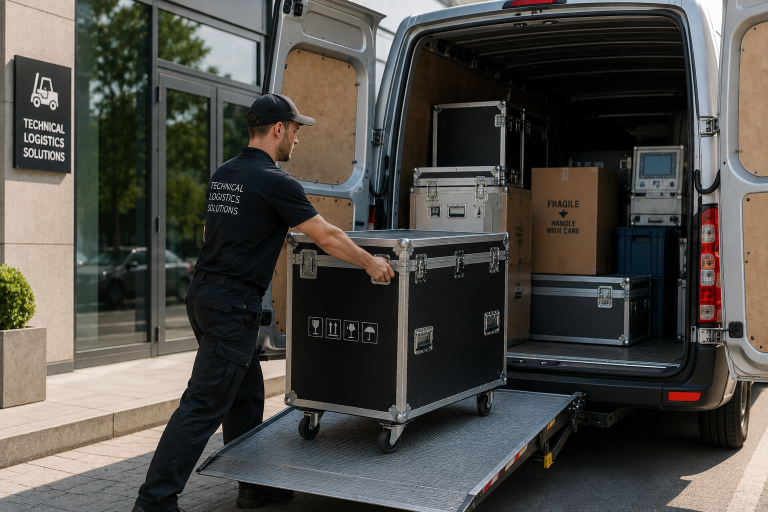
Specialised vehicles can also be important. Larger items may need vans with tail lifts or enough room to secure equipment correctly during transport. For sensitive equipment, the way an item is loaded and secured matters just as much as the route itself.
A good bespoke service is not complicated for the sake of it. It is practical. It gives the customer the chance to explain the shipment properly before anything is collected, so the delivery team arrives prepared rather than guessing on the day.
4. Installation, swap-out support, and immediate use after delivery
Many technical deliveries do not end when the equipment reaches the building. In some cases, the real job begins at that point. The item may need to be moved into a particular room, unpacked, placed in position, connected, checked, or handed over to engineers.
For some technical and medical equipment deliveries, customers may ask Distribusha to do more than simply place the item in the room. Equipment such as a Sylfirm X system or a Canfield Scientific VISIA 7 unit may need to be assembled, connected, powered on, and checked before it is left on site.
This gives customers confidence that the equipment has been delivered to their customer’s premises in working condition and is ready for the next stage, such as staff training, a scheduled trainer visit, or clinical use.
If a fault or setup issue is only discovered later, it can waste the trainer’s time, disrupt clinic staff, leave appointment slots empty, and affect the supplier’s reputation. Basic post-delivery checks help reduce the risk of failed training sessions, repeat visits, and avoidable downtime.
This kind of support is especially useful when a faulty unit is being replaced. A business may need a new component delivered quickly, while the damaged or outdated part is collected and returned. That swap-out process can help reduce downtime, because the customer does not need to arrange separate transport, removal, and return logistics.
Distribusha’s technical courier work can include installation where the task is suitable and not overly complex. That detail matters. For many customers, especially those with limited staff on site, it is not enough for equipment to arrive in the building. It needs to be in the right place and ready for the next step.
There is a practical benefit here. Engineers can continue with their work. Staff are not left dealing with heavy lifting. Operations can restart more quickly. The courier service becomes part of the support process, not just the transport.
5. Packaging disposal, recycling and responsible removal
Anyone who has received large technical equipment knows how much packaging can be left behind. Boxes, pallets, wrapping, foam, protective inserts, and plastic materials can quickly take over a room, especially in a clinic, office, laboratory, or retail site where space is already limited.
That is why packaging disposal can be more useful than it first sounds. Once the equipment has been delivered and placed where it needs to go, the customer may not want to spend the next hour dealing with waste packaging. Distribusha can remove packaging materials such as boxes, plastic wrapping, and pallets and take them for recycling where appropriate.
This is also useful when replacement equipment is involved. If a new unit is being delivered, the old one may need to be removed, returned, repaired, or sent for recycling. Handling that as part of the same visit makes the service cleaner and more efficient.
Of course, this should not be confused with hazardous waste disposal. But for normal packaging materials and suitable equipment removal, it is a simple detail that improves the whole delivery experience.
Timely deliveries for businesses where downtime is costly
In technical logistics, timing is not just a matter of convenience. It can affect whether a clinic can keep appointments, whether a project stays on schedule, whether engineers can complete work, or whether a business can keep serving its customers.
A missing machine part can hold up production. A delayed medical device can disrupt a working day. IT or networking equipment arriving late can slow down an installation. These are not abstract problems. They cost time, money, and patience.
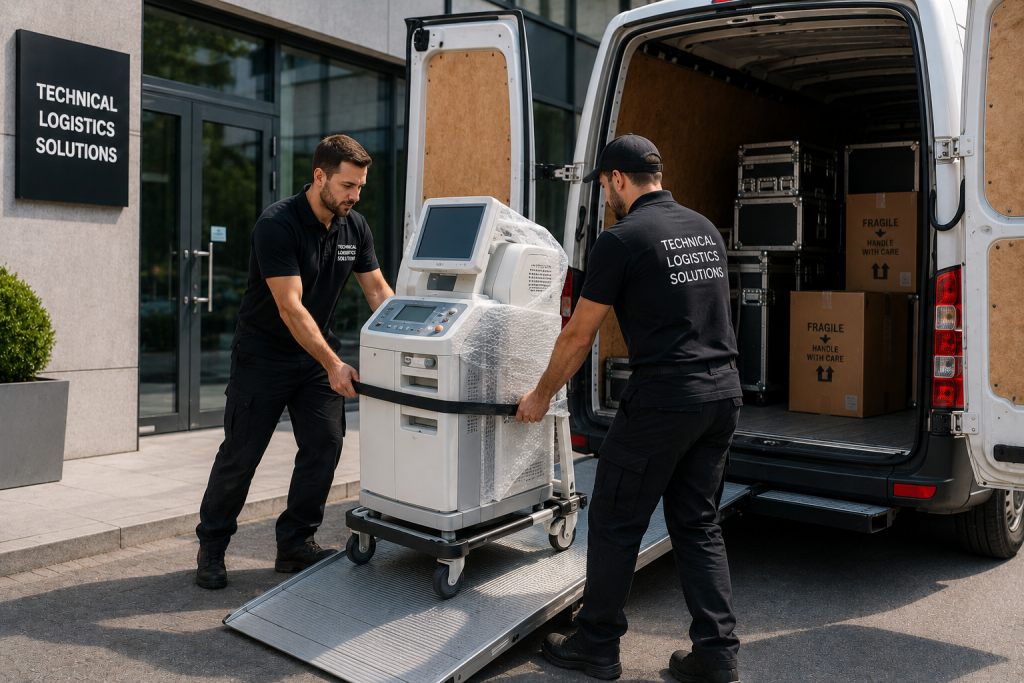
That is why timely deliveries need proper preparation. The courier team should know the pickup details, delivery address, contact person, access restrictions, preferred schedule, and any handling instructions before the item is moved. Clear communication also helps the customer track what is happening instead of chasing updates.
For businesses across the UK, from Milton Keynes to larger cities and regional sites, dependable timing is part of the value. A delivery that arrives when it should, with the right equipment and the right support, helps keep operations moving.
Case study: technical courier support for Canfield’s VISIA units
A case study often explains this type of work better than a long list of services. Distribusha’s work with Canfield and its VISIA® Generation 7 units is a good example.
The VISIA system is a specialist skin imaging device, so the delivery was not a basic drop-off. In one case involving River Anaesthetics in Bournemouth, the task included delivering a replacement component, supporting the core replacement, testing the unit, and arranging for the faulty core to be packaged and returned.
That kind of work shows why technical courier support matters. The service involved careful transport, site support, equipment handling, testing, and return logistics. It also helped reduce disruption for the customer, because the replacement process was managed in a joined-up way.
For companies comparing courier options, that is a useful point. Anyone can say they offer reliable delivery. A real technical logistics service proves its value when something needs to be fixed, replaced, tested, or returned without creating more work for the client.
Expertise and site-ready support at every stage
Behind every technical courier service we provide, there is careful planning, practical expertise, and attention to the small details that can easily be missed. Before a shipment moves, our trained specialists take into account the equipment itself, the delivery site, the customer’s schedule, and any relevant regulations that may affect the job.
That preparation helps us work with more precision, especially when we are dealing with sensitive devices, presentation equipment, medical units, or technology that has been in place for many years. Some deliveries are straightforward. Others involve access challenges, removal of old equipment, installation support, or coordination with engineers already waiting on site.
We also know that customers need clear communication. Where possible, updates and direct feedback help keep the process transparent, so our clients are free from unnecessary uncertainty while the delivery is being managed. The aim is not simply to move an item from one point to another, but to manage the task in accordance with the customer’s operational needs.
For any company that needs to maintain continuity, this level of support can make the difference between a difficult delivery and a smooth handover. When our team goes the extra mile, equipment can be delivered, positioned, and removed more efficiently, with less disruption for staff, engineers, and customers.
Choosing the right technical logistics partner in the UK
The right logistics partner should ask practical questions before the delivery happens. What type of equipment is being moved? How fragile is it? Is it heavy? Is the site easy to access? Does the customer need installation, removal, packaging disposal, or a timed delivery?
Those details matter because technical logistics is not built around speed alone. It is built around protecting the equipment, reducing risk, and helping the customer keep their operations running.
For businesses that rely on medical equipment, technical devices, machinery, IT networks, or specialist tools, a well-managed courier service can be a real operational benefit. It gives customers a single partner for safe transport, careful handling, removal, recycling, and support at the delivery point.
That is the difference between simply delivering equipment and managing a technical logistics process properly. When the item is valuable, sensitive, or urgently needed, that difference becomes hard to ignore.
Frequently Asked Questions
Yes. Technical courier services are often used when equipment, machinery or parts need to reach a site quickly because a delay could affect business operations, project timelines or customer service. For urgent requests, same-day delivery can help reduce downtime by getting replacement units, components or specialist devices to the right location without waiting for a standard courier schedule.
Some temperature-sensitive medical equipment and supplies can be transported with careful handling and rapid transit, but this should not be confused with refrigerated or frozen transport. If an item requires a fully temperature-controlled vehicle, this needs to be discussed in advance because not every medical delivery falls under the same regulations or handling requirements.
Technical couriers are useful for businesses that depend on delicate, high-value or operationally important equipment. This includes IT and telecom companies, healthcare providers, medical suppliers, laboratories, universities, engineering firms, manufacturers, retail technology teams and audio-visual or event production companies.
Yes, multi-drop delivery can be useful when technical equipment needs to be delivered to several branches, customer sites, clinics, offices or installation locations. This is especially helpful for companies rolling out new devices, replacing equipment across a network, or coordinating deliveries around engineers and site teams.
Customers should provide clear details about the equipment, including size, weight, packaging, collection point, delivery site, access restrictions and whether installation, testing, removal or packaging disposal is needed. Good preparation helps the courier team plan the right vehicle, handling method and schedule, which reduces the risk of delays, damage or confusion on site.
Contact Us
Rely on Distribusha for all your same-day courier service requirements. Reach out to us today to discover how we can best assist you
Get a quote
Recents posts:

Courier Pricing UK Explained: What Affects Delivery Costs?
Автор: UK courier prices are determined by six things: the type of service, the route, the vehicle, the deadline, the shipment itself, and the work
Case Study: Technical Reverse Logistics for Canfield VISIA-CR Equipment
Автор: Manufacturer-Guided De-installation, Packing and Return Shipping from Chelmsford to the USA Distribusha recently completed a specialist technical reverse logistics project involving a Canfield Scientific
Medical Courier Services vs Standard Courier Services: Key Differences Explained
Are you searching for medical courier services? Find about our expertise with medical deliveries in the UK and the importance of choosing the best medical courier.